Scroogle Alternative

Unfortunately, Scroogle seems not to be working at the moment.

Searching on the internet, the reason seems to be that either Google is blocking it, or that the site has been hacked by a DDOS.

Whatever the reason, as it is not working I am using an alternative search engine which isย http://privatelee.com/

Let me just explain why Scroogle is so important for SEO.

If you have a website and want to know where it ranks on Google for a particular keyword phrase, you can go to Google and scroll down to find out what position your website is in.

The problem with doing it this way is:

1. You may not be in the country which you want to know the position of your site.

2. Your searches are pretty much always personalized depends on which sites you have visited before and other factors also

Up until now, if you use Scroogle, you could enter a keyword phrase and obtain totally unpersonalized results.

As Scroogle is now down, that is not the case so I suggest that for the moment you use http://privatelee.com/

It works reasonably well, although the annoying thing is that it also has results from Yahoo. If you have another alternative, please let me know in the comments.

Keeping it real in an unreal world,

Ben Shaffer

Google does not use Copyscape

I love Copyscape.

I mean, REALLY love Copyscape.

What really concerns me
though is how many people in
our industry totally misunderstand
and indeed misuse Copyscape.

Have you heard someone say:

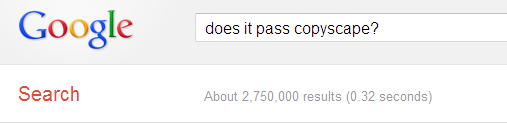
“Does it pass Copyscape?”

As you can see, over 2 million
people are questioning in some
way whether an article passes
Copyscape.

Which is kind of important…

…but in many cases also totally
irrelevant.

And it is important to know when
it is important, when it is not so
important and when it really
doesn’t matter.

I really don’t want to get into
the discussion of whether duplicate
content penalty exists or not.

In some way it almost certainly
does.

But what is more important, is
what you are using the content
for and whether it really matters.

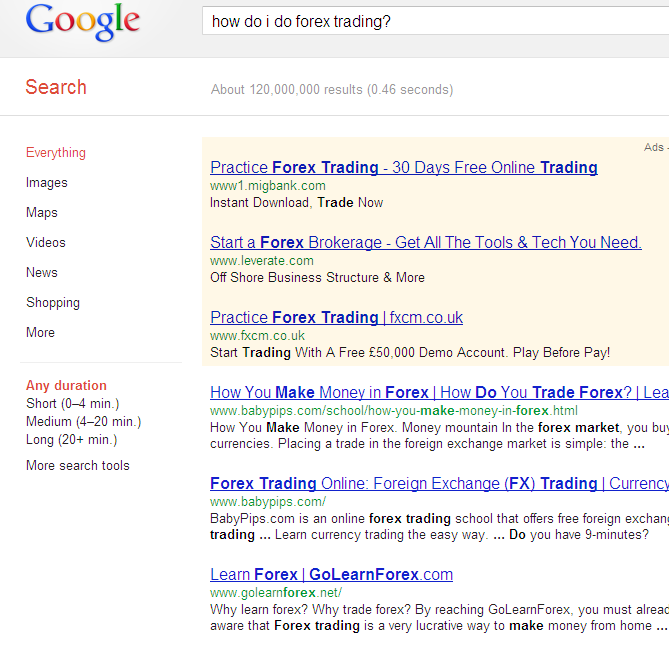
Let’s do a search on Google:

and take some text from the second
result (golearnforex.net)

“By reaching GoLearnForex, you must already be aware that Forex trading is a very lucrative way to make money from home”

Now if we do a copyscape search for that,
the top results that it gives are:

If we check Google/Yahoo/Bing to see if those
URLs are in the top 50 for that phrase, we find:

1. forex-dollars.info
Google: NO
Yahoo: YES
Bing: YES

2. golearnforex.net
Google: YES
Yahoo: YES
Bing: YES

3. lyricofsong.info
Google: NO
Yahoo: YES
Bing: YES

4. fcbgbahrain.multiply.com
Google: YES
Yahoo: YES
Bing: YES

5. retno.info
Google: NO
Yahoo: YES
Bing: YES

6. cempluk.info
Google: NO
Yahoo: NO
Bing: YES

7. gallery-tips.blogspot.com
Google: NO
Yahoo: NO
Bing: YES

(From what I understand, Yahoo and Bing share a lot
of results, but obviously aren’t exactly the same.)

It seems to suggest that Copyscape is making use of Bing
to get its results.

So, what does this tell us so far?

Not just that Google isn’t using Copyscape
to decide on whether to penalise duplicate content (duh!), but
that it is likely that Copyscape is putting
an empasis on results returned from Bing rather than Google.

THEREFORE, if you are optimising for Google
then it would be better to use Google itself
to check for duplicate content.

But that isn’t really point, as you will see
in just a sec.

Let’s take the phrase that we used before and
edit every few words:

“By reaching GoLearnForex, you must already be aware that Forex trading is a very lucrative way to make money from home”

changes to:

“By visiting GoLearnForex, you should already have awareness that Forex business is a quite lucrative way in order to earn from home”

and now what happens when we Copyscape that?

So, what we have done is to keep exactly the same
meaning to the phrase, but edited every third word
with a synonym.

So, now we are safe that this is not duplicate content?

No, not at all!

What we now know is that according to Copyscape
they don’t see it as duplicate content.

In reality, I would guess that Google will see it
in EXACTLY the same way as the original.

– the meaning is the same
– the majority of the words are even the same

I am 99% sure that Google does not only test
whether each particular phrase (of 3 words)
already exists in its index but does many many
more checks.

So, I just want to be clear about exactly what
I am saying here and what I am NOT saying!

1. Copyscape is EASILY the best tool for checking
duplicate content. However, it is just for that
and not necessarily to tell you the quality of
an article or ‘how Google sees it’

2. Google uses a far more complicated algorithm
than Copyscape or any other ‘human’ made tool
in order to decide the quality of your content.
I don’t know what it is. You probably don’t either.
And nor does anyone else outside of Google – probably.
But, if you are placing too much emphasis on Copyscape
to tell you the quality of an article then it is highly
likely that you are going to be burnt.

As an aside, I was badly burnt when I had a whole
load of articles written for me which passed all tests
in terms of duplicate content. Only afterwards did
I discover that he used a technique similar to that
above.

3. For different purposes, you need to use different
tools.

Copyscape is great/amazing for finding if someone
has stolen your content or a dishonest writer is
using someone else’s content.

However, as I showed above, this should be a first
test and not the ultimate one.

If you are using PLR content or spun content, then
Copyscape is (almost) irrelevant for trying to understand
the quality of the content.

I don’t generally advise that you should use either
as your primary content. But if you are using it
for backlinking to your site then whether it passes
copyscape or not is not so important.

If you are using spun content, then just the fact
that one instance is different from another makes
it FAR better than using an article that is exactly
the same as someone else is using.

So, next time you hear someone use the phrase:

Did it pass Copyscape?

try and understand exactly what it means and
how important it really is.

Keeping it real in an unreal world,

Ben Shaffer

Check Your Spintax

It is hard to create spun articles manually.

It is even harder to check the spintax to make sure that it is correct.

And if it is not correct, then to debug the problem.

As this is something which is very important to my company, I have just created a script which will do exactly that.

Go and take a look and let me know what you think at:

Check Your Spintax

Keeping it VERY real!

Ben Shaffer

5 Quick SEO Link Tweaks

Going to keep this quite short and sweet and show you some really quick ways on how to get some SEO love.

This is by NO MEANS an SEO guide!

These are not for you if you are just setting up a new site or page.

But if you need a quick push in the search engines. Or you are at position 11 and want to be in the top 10, then these work great for me:

1. Go and put a link to your website on the relevant page on Wikipaedia. They are nofollow but also v powerful.

2. Create a blogger blog and put a unique article on with a link to your main site.

3. Email the top 10 people in Google for your chosen keyword phrase. Be friendly and say something unique about their site.

4. Do 3 quality comments on related blogs.

5. Answer 5 Yahoo answer questions about your subject.

Told you it would be short ๐Ÿ™‚

Please post any other quick tipsย below.

Keeping it real in an unreal world,

Ben Shaffer

SEO is NOT a Jungle in 2012

I went to an SEO conference yesterday.

And although I didn’t learn a huge amount of tactics, it did help me define my SEO strategy

– or perhaps a philosophy –

which I thought you may find useful for me to share.

There seems to be a massive oxymoron in SEO.

On the one hand, Google says that we shouldn’t artificially create links.

On the other hand, gaining links to your website are definitely one of the top 2 factors which will decide on where you are positioned in the search engines.

So, how do we build links, where any linkbuilding is in itself artificial?!

It was very interesting to hear from people outside of our internet marketing commmunity – some of whom are really on the cutting edge of SEO.

These are people who are working in leading international SEO companies who are dealing with extremely high profile clients.

They are running 100s of tests daily to see what is working and what is not working.

IMHO, a far cut above from the internet marketing community whose ‘new’ advice is the next best place where you can get links.

I will definitely share more in a future blog post, but here are some things which came out at the conference and which I believe are true:

1. You can be penalised for incoming links

Many people counteract this arguement by saying that if this were the case, then you could harm your competitor by linking to them from bad neighbourhoods.

Well, um…yeah.

It also seems to be the case, that Google looks at your links as a whole, so if you have 1k bad links and 1k good links, then the good links will be devalued by the bad links.

Think about that when you do your next Xrumer or Scrapebox campaign ๐Ÿ™‚

2. Social factors are being used more and more to determine search position

I don’t think that anyone would argue with this. However, it seems that it is actually becoming a MAJOR (with a capital M) factor and if you are not using it, then you are missing out.

Although, I hate to blow my own trumpet, this is exactly what my message was about 6 months ago when I came out with Instant Profit Booster which was my course on exactly how I am doing that.

3. Some of your pages can affect the rest of your site

It sounds kind of obvious when I say this, however it is not something which I had thought of before.

But what does this mean in practice?

What it means is, that if you have some low quality pages, then they can give a negative effect to your whole site. So in many cases, it may be better to actually eliminate lower quality pages in order to bring the quality of your whole site up.

Call it trust score.

Call it quality score.

Comes down to the same thing…

4. Google does know… ๐Ÿ™‚

I think that this is a massively important thing to remember. They know what we are doing on the internet in terms of backlinking.

They have 100s of engineers working on the internet and 1000s of people around the world manually checking sites and feeding back any obvious patterns to the algorithm.

There are some things which you will get away with either in the short term or the long term though.

But you won’t really know that unless you are testing ‘doing it’ and not just ‘doing it’.

There is an easy way to keep Google happy and that really is to pay attention to delivering what visitors want.

5. Different niches should be treated differently. Not only in the force of your linkbuilding, but also in how you should be doing your linkbuilding.

A massively easy way to know what is working for your niche is to look at your competitors.

6. There seems to be some arguement on how powerful long tail keywords are.

As a reminder, 30% of keyword phrases searched are either search for the first time or haven’t been search for in the last 90 days (usually misquoted without the last bit!)

On one hand, if someone is searching for:

large blue widgets

they may be better served by going to a site which is specifically about large blue widgets.

On the other hand, it is also likely that a site about blue widgets will also discuss both large and small blue widgets and therefore will be able to supply the information.

As a sidenote, when creating content for your site, do you think that Google genuinely wants you to have 3 separate pages for:

cheap halloween costumes
low cost halloween costumes
halloween costumes that are cheap

Generally, all three pages will have identical information on them, even if written slightly differently. You may want to try just creating one higher quality page which has all of the information there without duplication.

Another connected point to this, is that different keyword phrases will convert differently for you. Apparently there is evidence to suggest that the main keyword phrase + 2 words will convert the best.

So, for example if your main keyword phrase is “dog training”, then “dog training for labradors” has a higher chance of actually converting than just “dog training”

So, my Google/SEO predictions for the year ahead?

a. I think at some point that exact domain name matching will become less powerful. It just doesn’t seem logical that it should be as powerful as it is. Just because you have a domain with an exact keyword phrase, doesn’t actually mean that you will be the site which delivers to the visitor what they are looking for.

In many (or even most) cases, from an objective point of view this simply will not be the case.
b. Social media will become more and more important for the majority of niches. The fact that you are spending time or money on social media also tells Google that you have some authority in your niche.
c. More and more, we should be giving Google what they want in order to get great positions in the search engines. By putting a larger emphasis on the manual viewing of sites they are showing that if you don’t give them what they want then they will make you suffer.

Either eat it up or lose out…

In conclusion, the vast majority of Google’s revenue comes from advertising. In order to continue and even increase that revenue, they need to do two things:

1. Keep advertisers happy
2. Make sure that searchers continue to use Google in such mass

1. They can keep advertisers happy by making sure that they get targeted visitors to their website and make a positive ROI.

They will not be able to do that if ads are placed on spammy or low quality sites as the visitors to those will likely be lower quality prospects and also will start to trust Google/AdSense less.

(Read that paragraph again – it’s really important)

2. In order to keep searchers using their search engine and clicking on their ads they need to make sure that they are delivering the best possible results.

If you are not ranking, it is unlikely to be that they hate you (or even your website) but more likely that based on the profile that they have of you and your website, you are unlikely to present the best content to the person who is searching for your information.

It is important to keep account of the search engine updates when they are occur, but the overriding factor when deciding your website strategy, is to ensure:

a. You build a site with quality and relevant content
b. You put up content that people will actually want to link to and THEN go about getting the links.

I know I’ve said a lot in this post ๐Ÿ™‚

Do you agree/disagree? Please do leave a comment below.

Especially interested to hear your own predictions on where SEO/Google is moving.

Keeping it real in an unreal world,

Ben Shaffer

PS. Oh yeah…If you could like, share or link to this article that would be great ๐Ÿ™‚